


Is Tall Fescue for Utah Lawns Right for You?

A Utah lawn has to earn its green. It faces high-desert sun, hot pavement, thirsty soils, cold winters, and the kind of summer heat that exposes every weak spot in a landscape. That is why tall fescue for Utah lawns has become a serious choice for homeowners and landscape professionals who want a lawn that stays usable, attractive, and deeply rooted when conditions get demanding.
Turf-type tall fescue is not a shortcut to a no-water landscape. No living lawn can promise that. It is, however, one of the strongest cool-season turf options for Utah properties that need better heat tolerance, a durable playing surface, and meaningful water efficiency without giving up the rich green lawn people actually want to use.
Why Tall Fescue for Utah Lawns Performs Differently
Tall fescue is built from the roots up. Modern turf-type tall fescues develop a deep, substantial root zone when they are properly watered and maintained. Those roots can reach deeper into the soil profile than many shallow-rooted turf choices, helping the lawn access moisture below the surface during hot, dry stretches.
That matters in communities from Salt Lake and Lehi to Provo, Richfield, and St. George. Utah weather does not always follow a tidy schedule. Spring can turn warm quickly, summer heat can arrive early, and rainfall is rarely something a property owner should count on. A deep-rooted turf gives you more margin when the forecast is unforgiving.
The difference is visible, too. Quality turf-type tall fescue has a finer blade than old-fashioned pasture fescue, along with a dense, uniform appearance and a dark green color. It creates a lawn that feels good under bare feet, holds up to kids and dogs, and gives a home or commercial property the finished look rock and artificial turf simply cannot provide.
Tall fescue also handles heat better than many traditional cool-season grasses. It will still prefer reasonable summer irrigation, especially in full sun, but it has a useful ability to keep functioning through hot periods rather than fading at the first sign of stress. That makes it a practical option for broad sunny yards, active common areas, and properties where the lawn needs to perform rather than merely survive.
Is Tall Fescue the Best Fit for Your Yard?
The right grass depends on how you use the space, how much sun it receives, and how you prefer to manage irrigation. Tall fescue is an especially good fit for homeowners who want a lower-input cool-season lawn with a strong root system and good summer durability. It is also a smart choice for contractors and property managers who need dependable turf across larger, exposed landscapes.
A tall fescue lawn is often well suited to full sun and light shade. It tolerates shade better than some warm-season choices, but dense shade under mature trees or along the north side of a building can still limit any turfgrass. If an area receives only a few hours of filtered light, grass selection alone will not solve the problem. Pruning for light, improving drainage, or reducing the lawn area may be the more honest answer.
Kentucky bluegrass remains an excellent option for Utah lawns, particularly when self-repair matters. Bluegrass spreads through underground rhizomes, allowing it to fill small damaged spots over time. Tall fescue is primarily a bunch-type grass, so it does not spread laterally in the same way. If a section is severely damaged by pets, construction, or repeated traffic, it may need overseeding or a small sod repair.
That trade-off is worth understanding before installation. Choose tall fescue for its deep rooting, toughness, and water-wise potential. Choose bluegrass when rapid self-repair is the top priority. On many Utah properties, either can produce a beautiful lawn when the turf is matched to the site and cared for correctly.
Water Deeply Instead of Chasing the Surface
The biggest mistake with tall fescue is watering it like a shallow-rooted lawn. Short, frequent irrigation keeps moisture near the surface and trains roots to stay there. That creates a lawn dependent on constant watering precisely when Utah water management calls for better habits.
Instead, water deeply enough to wet the active root zone, then allow the surface to dry somewhat before the next cycle. The exact schedule changes with soil type, slope, weather, sprinkler output, and the age of the lawn. A sandy area may need more frequent applications than a heavier silt loam soil. A south-facing slope will lose moisture faster than a protected side yard.
The goal is not to follow a fixed calendar. The goal is to observe the lawn and use water with purpose. A lawn showing a dull blue-green cast, folded leaf blades, or footprints that remain visible may be asking for water. Runoff, puddling, and constantly wet soil are signs that water is being applied too quickly or too often.
Healthy turf is part of a working Utah landscape. Its root system helps hold soil in place, encourages infiltration, cools the area around a home, and creates a living surface where families gather. Reducing waste does not require giving up functional green space. It requires growing the right lawn and managing it well.
Starting Tall Fescue Sod the Right Way
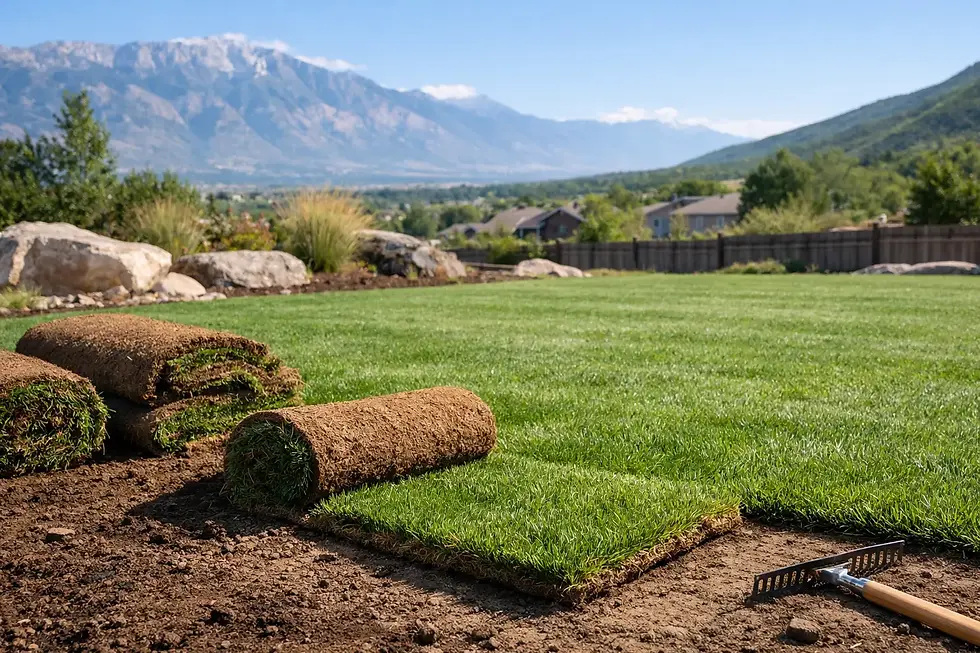
Sod gives tall fescue an immediate advantage over seed: the property begins with a finished, dense surface instead of months of bare ground, weeds, and uncertain establishment. Fresh-cut sod can quickly turn a construction site or tired yard into a usable landscape, but installation day still matters.
Prepare the soil before the sod arrives. Remove debris, control existing weeds, smooth major low spots, and make sure the finished grade directs water away from structures. Loosen compacted soil where practical, especially on new construction sites where equipment traffic has squeezed the life out of the root zone. Good sod deserves good soil contact.
Lay sod tightly in a staggered pattern, similar to brickwork, without stretching pieces or leaving gaps between seams. Begin along a straight edge and work outward. On slopes, run pieces across the slope when possible to reduce slipping and erosion. Once the lawn is installed, roll it lightly if needed to settle the roots against the soil.
For the first several weeks, the priority is keeping the sod and the soil beneath it consistently moist while roots knit into the site. Lift a corner occasionally to check progress. If the sod lifts easily and the soil below is dry, it needs more attention. Once rooting is established, transition gradually toward deeper, less frequent irrigation.
At All American Sod Farm, American Oasis™ is a turf-type tall fescue blend selected for the uniformity, deep rooting, and rich color Utah customers expect. Sod grown in Ferrozite, an iron-rich, nutrient-dense silt loam soil, arrives with the strength to establish quickly when it is installed and watered correctly.
Mowing and Feeding for a Dense, Durable Lawn
Tall fescue should generally be mowed higher than a tightly clipped show lawn. A height around 3 to 4 inches is a strong target for many Utah yards, particularly through summer. More leaf blade means more photosynthesis, better soil shading, and less stress on the crown and roots.
Keep mower blades sharp. Dull blades tear grass tips, leaving a gray or tan cast across the lawn and making turf look stressed even when it has enough water. Follow the one-third rule: do not remove more than one-third of the blade in a single mowing. If the lawn gets away from you during a busy week, lower the height gradually over two mowings instead of scalping it back at once.
Fertilizer should support the season, not force excessive growth in summer. Tall fescue responds well to thoughtful fertility, with much of its nutrient need commonly addressed in spring and fall. A soil test is the best way to avoid guessing, particularly in new landscapes or lawns that repeatedly show thin growth or poor color.
Aeration can also make a noticeable difference in compacted Utah soils. Pulling cores in fall opens pathways for air, water, and roots, while reducing the hard surface layer that limits infiltration. For high-traffic family yards and commercial turf, aeration is often one of the most practical investments in long-term lawn performance.
Build the Lawn Around Real Life
A successful tall fescue lawn is not the one that looks perfect for a week after installation. It is the one that still looks inviting after a July barbecue, a dog’s daily patrol, kids running through sprinklers, and a long stretch without meaningful rain.
Plan for the conditions you actually have. Put durable turf where people gather and play. Improve irrigation coverage before blaming the grass. Give the root zone room to work. With that foundation, tall fescue can provide the cool, green, resilient outdoor space that makes a Utah property feel like home.


Comments